
Private Jack Harold Hartley
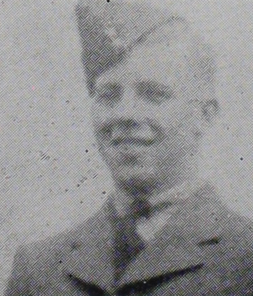
Jack Hartley was born in Paris in 1923, the son of Wilfred Hartley and Jessie Adelaide Creeden, who were born in England. The family lived on Washington Street for a time.
Jack enlisted with the Royal Hamilton Light Infantry (RHLI) during the Second World War, and in 1941 left Canada destined for Northern Ireland. As part of the 4th Canadian Infantry Brigade, 2nd Canadian Infantry Division, the regiment arrived in Great Britain in August 1940. Following the threat of a German invasion, the 2nd Canadian Division was dispatched to Northern Ireland in the summer of 1941 to bolster defenses and train for the eventual return to mainland Europe. The RHLI spent several months stationed in Northern Ireland conducting rigorous training before relocating to the south of England in 1942 to prepare for the ill-fated Dieppe Raid.
It is not yet known if Jack Hartley was part of the contingent to Dieppe. The Dieppe Raid, also known as Operation Jubilee, was a disastrous Allied amphibious attack on the German-occupied port of Dieppe, France, on August 19, 1942. It involved over 6,000 troops, mainly Canadians, with the aim of testing the feasibility of an amphibious assault on Nazi-occupied Europe. The raid was a costly failure, resulting in heavy casualties and demonstrating the strength of German defenses.
The raid was intended to test amphibious assault tactics, gather intelligence, and potentially disrupt German shipping and radar technology. It is also suggested that a top-secret Enigma code machine was a target. The Enigma code refers to the encryption method used by the German military during World War II. While considered nearly unbreakable, Allied codebreakers led by Alan Turing, were able to decipher Enigma messages, significantly impacting the war.
The raid involved a large contingent of Canadian soldiers, including the Hamilton Light Infantry, supported by British commandos and a small number of US Rangers. It was a major setback for the Allies. The German defenses were stronger than anticipated, and the Allies suffered heavy casualties. Over 900 Canadians were killed, and thousands more were wounded or captured.
While a failure, the Dieppe Raid provided valuable lessons used on D-Day, including the need for better air and naval support, and the importance of understanding beach conditions and German defenses. The raid is remembered as one of the bloodiest single-day losses for the Canadian Army in World War II.
Whether or not Jack was part of the Dieppe disaster, he returned to Canada and married Doreen Elizabeth May Smith of Toronto. They lived in Brant and Wentworth counties until 1995. In 1997, they had moved to 9 Curtis Avenue South.
Private Jack Hartley died in September, 1998 and is buried with Doreen in the Paris Cemetery.
- sibling of: