
20 West River Street
Corporal William Stokes McQueen
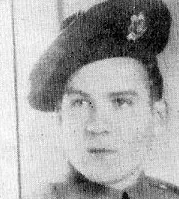
William Stokes McQueen was born in Brantford in 1920, the youngest of four children. His parents, Murdock McQueen and Elizabeth McCracken, lived for a time in Falkland, on a tobacco farm, but the family later moved to 20 West River Street in Paris. William played hockey and enjoyed fishing and hunting. He quit school when he was 13 years old and worked as a mechanic. He also had an interest in welding.
He enlisted with the Highland Light Infantry in Galt in June, 1940. He was classified as a driver and trained in Canada for over a year before shipping out from Halifax for Scotland. He underwent more training there and was promoted to Corporal. In January 1944, he took a driving course for a Loyd Carrier, a small tracked armored vehicle intended to move equipment and personnel on the battlefield. It would also be used on D-Day to haul a six-pounder anti-tank gun. During his training here, he earned a Good Conduct Badge. He would not have known it at the time, but this training was in preparation for Operation Overlord, the Allied assault against Germany’s occupation of continental Europe. It began with D-Day.
D-Day was the most pivotal battle of the Second World War. On June 6, 1944, the Canadian Army played a significant role in the Allied invasion of Normandy, France, specifically landing on Juno Beach. The 3rd Canadian Infantry Division and the 2nd Canadian Armoured Brigade were the main forces involved, with the Royal Canadian Navy and Royal Canadian Air Force providing crucial support. The Highland Light Infantry of Canada (HLI of C), Willliam’s regiment, landed on Juno Beach on D-Day as part of the 9th Canadian Infantry Brigade. They were part of the second wave to land on Juno Beach, arriving later in the day. They successfully landed 723 troops on Juno Beach and advanced inland, securing objectives before the end of D-Day.
Some of the fiercest fighting during the Second World War occurred in the days and weeks after D-Day, as Germany mounted desperate counter attacks against Allied forces. It is in this period that William Stokes McQueen was killed.
As a driver, one of his responsibilities was to pick up wounded soldiers and take them from danger. It was on one of these missions that William was hit by German sniper fire. Though wounded himself and under heavy mortar fire, he managed to drive several wounded soldiers to the Regimental Aid Post, where he collapsed. He died the next day, June 9, near Caen, France.
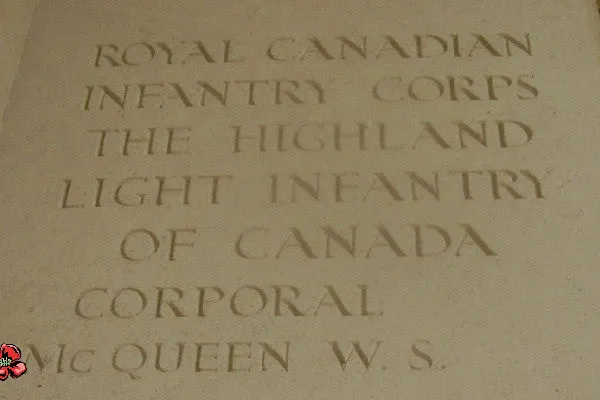
He is memorialized at the Bayeux Memorial, located on the outskirts of Bayeux in Normandy, about 24 kilometers north-west of Caen. The memorial was erected in honour of the 1,803 men of the land forces who died in the fighting in Normandy and in the advance to the River Seine, and who have no known grave.
Stokes Brothers
- McQueen, William Stokes
- McQueen, George M